
Federal Release Paths
A BOP release can lead to the community, federal supervised release, a residential reentry setting, or another custodian. The locator's “Released” or “Not in BOP Custody” status means the person is no longer held by BOP. It does not state that all legal restraint has ended. BOP itself warns that another correctional or law-enforcement system may hold the person.
A detainer is a request or legal basis for another agency to take custody when BOP custody ends. State, county, immigration, or other federal authority can receive the person. Federal supervised release is court-ordered community oversight after prison and is distinct from Mississippi parole. Follow the destination and supervision jurisdiction in the formal record.
Confirm a Federal Release
Use the BOP Inmate Locator. Search by BOP register number when possible. The locator also accepts DCDC, FBI, or INS numbers, or a name with age, race, and sex filters. Compare every identifier before relying on the result.
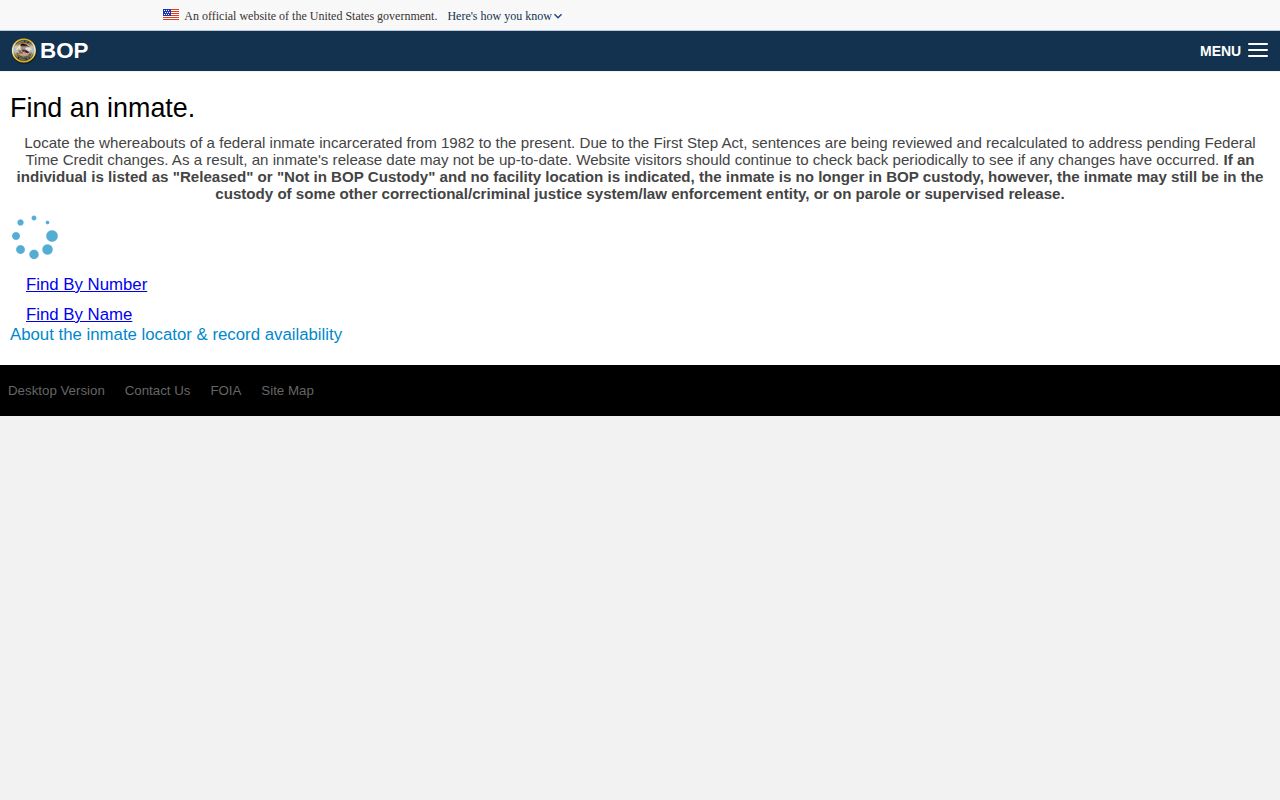
The captured locator layout shows why the release date must be read beside the federal location or status.
- Enter the federal number or full biographical search.
- Open the correct result and record the register number.
- Read the release date with the location or status.
- Check the federal court docket for supervision or later orders.
- Use BOP FOIA for a durable record when the locator is not enough.
The locator covers federal records from 1982 forward. First Step Act recalculation can change a displayed date. A prior projection is evidence of what appeared then, not proof of the actual event. The Jefferson Davis County release search should be used instead for local jail custody.
Federal Release Locator Fields
BOP results can show name, register number, age, race, sex, release date, and location or status. The register number is the strongest key. A release date beside “Released” gives a public BOP event, while “Not in BOP Custody” must be read narrowly.
| Locator item | Meaning |
|---|---|
| Register number | Federal identity key for the record |
| Release date | BOP's displayed federal custody date |
| Released | No longer in BOP custody |
| Facility location | Current BOP placement when shown |
A name alone can match the wrong person. Confirm the number and biographical fields. When another locator shows current custody, the systems may both be accurate because BOP custody ended through transfer.
Federal Release Record Proof
BOP's BP-A0714 Notice of Release and Arrival shows why a federal release is more than one date. Its fields include release date and method, institution, register and FBI numbers, community release versus detainer, detaining agency, supervision jurisdiction, proposed residence, transportation destination, and reporting instructions. Those details can distinguish freedom in the community from a handoff.
Requesting a former-inmate record requires enough identifying information. Privacy and authorization limits may apply. BOP FOIA is the records fallback after the public locator. Ask for the release notice or another releasable record sufficient to show the date, method, destination, and receiving authority rather than requesting an unfocused entire file.
Federal Release History Since 1982
BOP's public locator reaches back to 1982. This long historical window is radically different from the ICE locator, which shows people released from ICE custody only during the prior 60 days. A federal no-result must be interpreted according to the custodian and date.
For pre-1982 federal records, a name mismatch, or custody managed by another federal component, turn to the federal court clerk and records process. The United States Marshals Service has no comparable public historical released-person locator. A BOP no-result cannot establish a USMS or ICE release.
USMS Release Record Route
The Marshals Service may hold or transport federal defendants before a BOP sentence placement. Follow a sentenced federal prisoner through BOP, but use the court docket and responsible federal district when USMS custody is at issue. A targeted DOJ or USMS record request may be needed for an older event.
PACER or the federal court clerk can reveal detention, release, judgment, and supervision orders. The signed order establishes legal authority; the custodian's executed record establishes the physical handoff or departure. Keep both dates when they differ.
Federal Facilities Outside Jefferson Davis
No BOP prison was identified in Jefferson Davis County. The federal page is therefore a system route, not a claim that a local federal institution exists. A county arrest does not become federal custody unless federal authority actually takes the case or receives the person.
The Jefferson Davis County Sheriff cannot certify a federal prison release. BOP cannot certify release from the county jail. Use the agency that held the person and then follow any destination to the next custodian.
Federal Release and Supervision
Federal supervised release is imposed by a federal court and usually follows prison. It is not Mississippi parole, and the Jefferson Davis Probation and Parole Office does not manage it. The judgment and federal docket identify the term and later court action. The BOP locator identifies federal prison custody, while the responsible federal probation office handles court supervision.
A release date can change before execution. BOP notes that First Step Act calculations may alter displayed dates. Court orders, sentence credits, detainers, and processing can also affect the actual handoff. When a prior locator capture and a later record differ, retain both retrieval dates and seek the final release notice or other executed BOP record.
The result “Not in BOP Custody” is precise but limited. It can coexist with county jail, state prison, USMS, or ICE custody. Search each named receiving authority. For a Jefferson Davis County connection, the sheriff's departure record may show when local custody ended, while BOP supplies the later federal prison event. Neither record should be stretched beyond its own custodian.
Match Federal Release Identity
Federal register numbers reduce confusion between people who share a name. Compare the number, age, race, sex, court case, and known facility history. Do not use a photograph alone as the identity key. If the locator returns several people, the federal docket or sentencing record can supply the correct register number.
For an old or missing record, state what was searched and when. The locator's 1982 starting point, spelling differences, and custody by another federal component all affect interpretation. A well-scoped FOIA request should include the full name, register number, birth date, and requested date range.
Federal Release Evidence Chain
A federal court order, BOP locator result, and BOP release notice answer different questions. The judgment explains the prison term and supervised-release term. The public locator gives the BOP status and displayed release date. The Notice of Release and Arrival can identify the method, destination, detainer, supervising jurisdiction, and reporting direction. Keep these sources together when the path matters.
If the locator date conflicts with a prior projection, do not calculate a replacement from the sentence alone. First Step Act credit changes, amended judgments, detainers, and agency processing can alter the expected date. Request the executed record through BOP FOIA and examine the federal docket for later court action. Label every screenshot by retrieval date.
A detainer can send the person straight to another custodian. Follow the BP-A0714 receiving agency or the locator's status with the relevant county, state, ICE, or federal office. A person can be outside BOP yet remain confined. Federal supervised release also continues court authority in the community, even though the prison term has ended.
For a Jefferson Davis County connection, begin with the system that held the person on the target date. A county jail docket may document transfer to federal authority. The federal docket then shows detention and sentence orders, while BOP documents prison custody. If USMS held the defendant before BOP designation, use the court clerk, responsible district, or a targeted DOJ or USMS request. No one locator covers every federal component.
Federal Release Request Scope
Keep the federal register number in every follow-up request. It distinguishes the person across locator results, prison records, and court references. Where lawful access is limited, ask for the smallest releasable event record rather than a full former-inmate file.